
AI Won’t Create a Permanent Underclass. Socialism Will.
The case for redistribution without socialism.

“The same oligarchs who shipped jobs overseas now want to replace tens of millions of American workers with AI,” Bernie Sanders recently declared. “Our message to them is: Go to hell.”
The anger lands. Half of American workers are worried about the impact of AI on their workplace. A third think it will reduce their job prospects, while only 6% think it will create more.
Sanders has proposed a moratorium on AI data centers until worker protections are in place. Rhode Island now protects cashier jobs by law—one staffed lane per three self-checkout stations, plus employees whose only job is to watch the machines. Among Democrats, socialism now polls higher than capitalism, and the DSA’s new platform imagines food, energy, medicine, and transportation as public utilities rather than businesses.
People are scared AI will condemn them to a permanent underclass—and a socialist response is gaining ground. When disruption threatens something essential—your job, your wages, your ability to afford basic goods—government intervention offers immediate stability: preserve the job, cap the price, delay the technology. Each measure moves more of the means of production—the nitty-gritty of how problems get solved—under political control.
But it is these socialist policies, not disruption itself, that make disadvantage permanent. Markets do not merely destroy old arrangements; they replace them with better solutions. Move production out of the market, and you remove that problem-solving mechanism. The status quo survives while the rest of the world advances, and AI is about to accelerate that progress. For the people protected from change, stability becomes stagnation.
AI will be massively disruptive. We need an ambitious policy response that helps people weather the volatility without sacrificing the abundance the technology can create. We urgently need redistribution to give every American a stake in that abundance—because otherwise, they will burn it down before it arrives.
But redistribution does not require socialism. We can share wealth, put purchasing power in the hands of every American, and let private actors compete to solve everyone’s problems. We can protect people without freezing the economy in place, allowing markets to adapt as quickly as technology does.
To understand why, we need to stop treating redistribution and socialism as the same thing.
Redistribution ≠ Socialism
American political commentary often treats “redistribution” and “socialism” as interchangeable points in the middle of a flat economic spectrum. The usual line runs from laissez-faire capitalism at one end to communism at the other, with socialism somewhere in between.
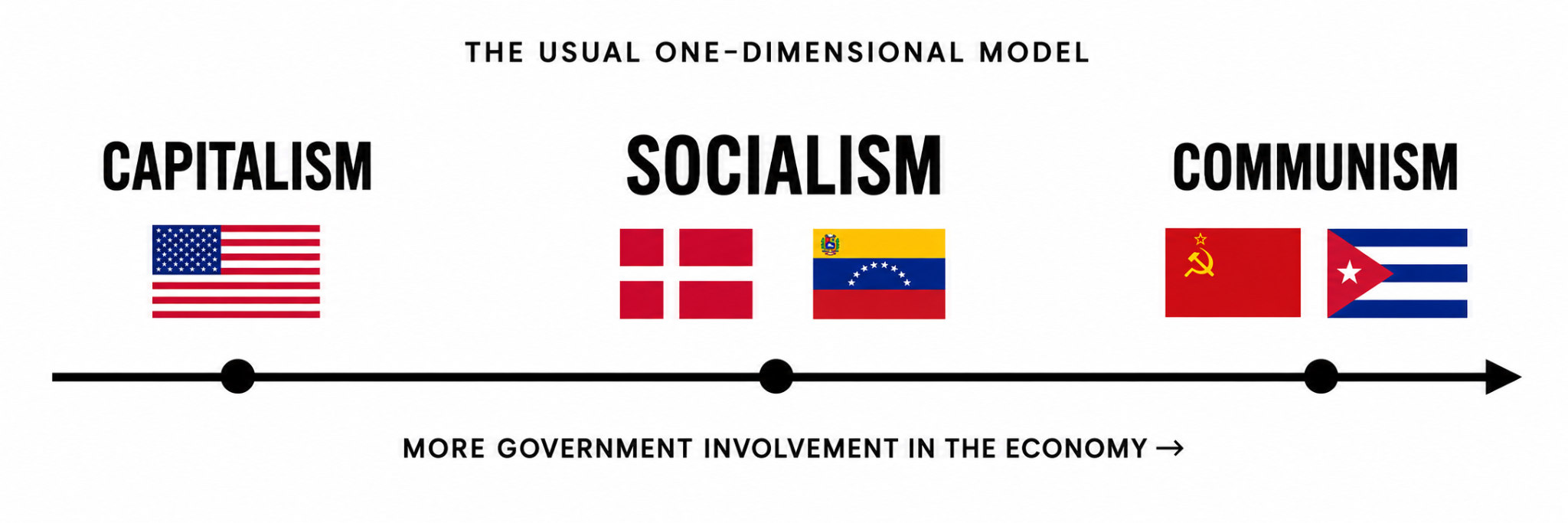
This linear model collapses two entirely separate questions.
The first: Who controls production? Is economic activity directed from the top down by the state, or coordinated from the bottom up by competitive markets?
The second: How broadly is purchasing power distributed? How much of the wealth an economy produces is shared?
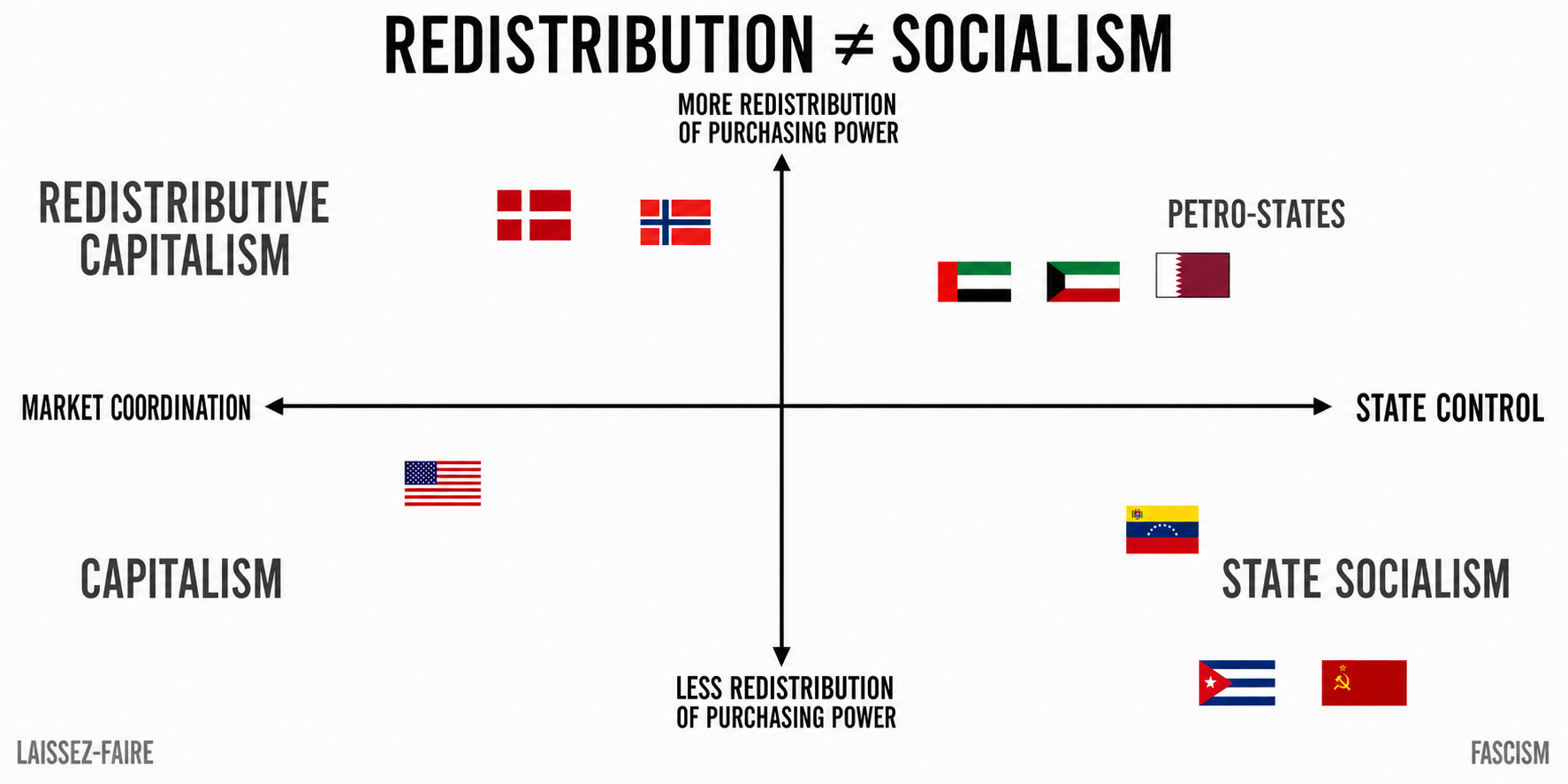
Why are “communist” countries like Cuba and the Soviet Union low on the redistribution axis? Because we’re looking at redistribution of purchasing power. For the most part, each of these countries prioritized distribution of state-rationed goods over flexible purchasing power like cash transfers or vouchers.
Once you separate these questions, it becomes obvious that Denmark and Venezuela aren’t just using different amounts of socialism. Both have tried to give ordinary people greater security and a broader share of national wealth, but they pursue it through almost opposite mechanisms.
Denmark’s Nordic model combines a large welfare state with private ownership and a thriving market economy. Denmark enables that economy to create wealth, taxes a large share of it, and redistributes purchasing power so more people can benefit from and participate in the market. As former Danish prime minister Lars Løkke Rasmussen put it:
“Denmark is far from a socialist planned economy. Denmark is a market economy.”
Under Chávez and Maduro, Venezuela pursued those goals through much more direct state control: nationalizing industries, controlling prices and access to currency, and politically directing production. Instead of using redistribution to give more people leverage within the market, it has tried to replace market coordination with state control.
Socialism tries to solve people’s problems directly. The government runs the school, assigns the housing, controls the rent, or mandates the job—removing competition, consumer choice, and market feedback.
Formal state ownership isn’t the only way to suppress market coordination. When governments set prices, dictate operating practices, select providers, or decide who may compete, the feedback that makes a market work disappears. In America, socialized control more often arrives as orchestration than nationalization: private prisons on government contracts, private insurers administering government-designed plans, private colleges feeding on government-guaranteed loans. The players are often private, but the market is not.
Redistribution doesn’t require any of that. We can redistribute wealth while interfering as little as possible in how goods are produced—allowing capitalism to make the pie as large as possible while saving a meaningful slice for everyone. That support might take the form of cash, a negative income tax, funded education or healthcare accounts, or shared ownership of productive capital. This puts economic leverage back in the hands of the people we’re trying to help, and mobilizes the entire economy to solve their problems as effectively as possible at the cheapest price.
Redistribution funds people. Socialism funds institutions.
Socialism: The sticky floor
Socialist-style interventions can provide a social floor, but that floor tends to be sticky, because these interventions create incentives that resist solving the very problems they were intended to solve.
They do this in at least three ways:
Prevent beneficiaries from finding better solutions
Remove the market mechanisms that might otherwise fix the problem
Create institutions that depend on the problem for survival
Any benefit that isn’t universal needs eligibility rules: the state must decide who qualifies and when they stop qualifying. Those rules create perverse incentives that make the floor sticky.
Some recipients face cliffs so steep that taking a job or a raise leaves them worse off. Public school students can’t take their funding to shop around for a better school. Tenants with rent control can’t carry their discount with them, so moving to a better apartment, a cheaper location, or a place that might be a better fit long term means giving up the benefit. The social floor provides short-term relief, but it undermines the potential for long-term improvement.
Similarly, these programs often prevent the market from identifying better solutions for these beneficiaries. Schools don’t compete for students who can’t choose where they learn. Landlords have little incentive to improve apartments where they can’t charge higher rent. When required repairs cost more than a landlord can recover through rent, rent-stabilized apartments sit vacant, even during a housing shortage.
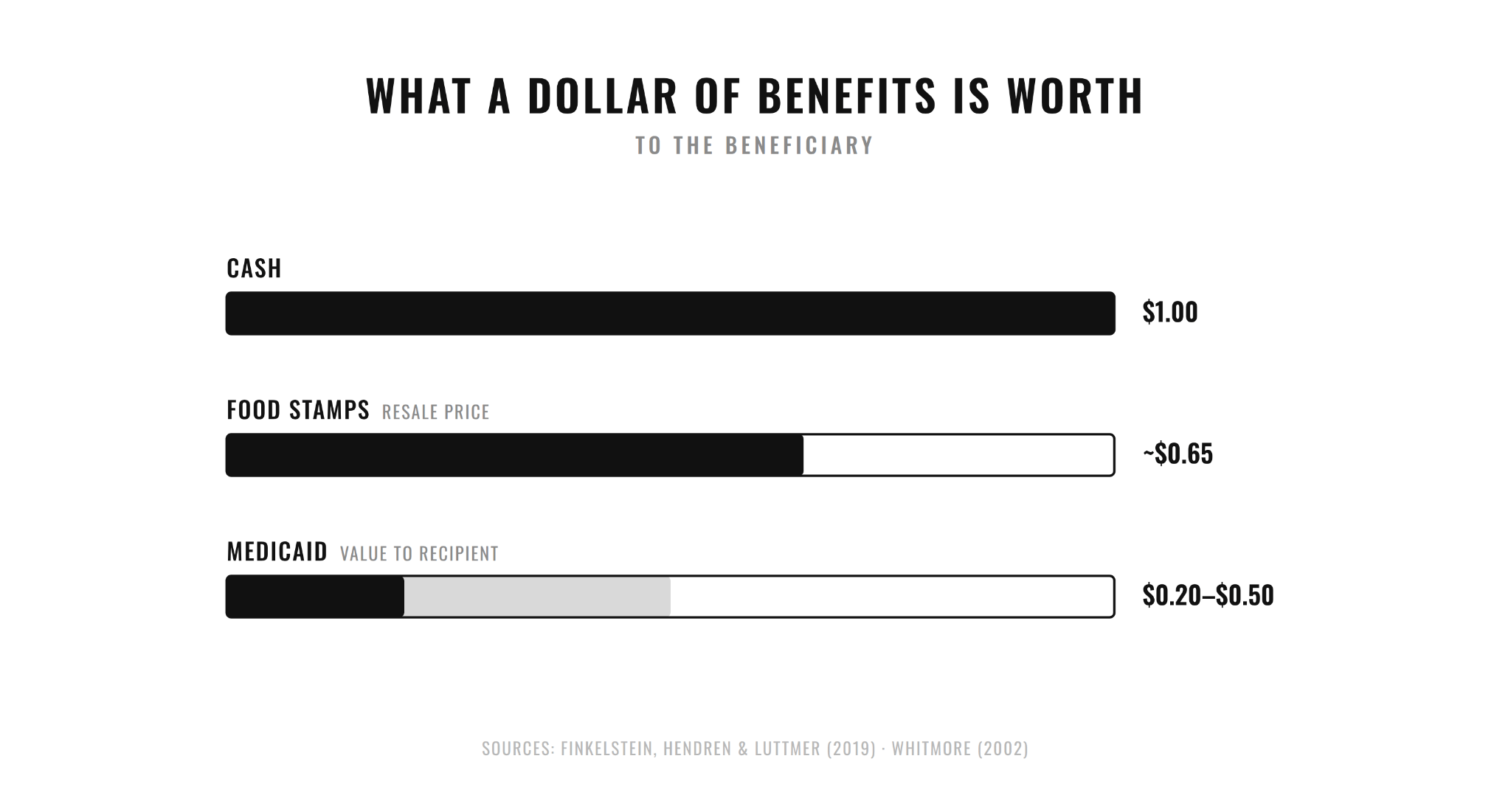
Government benefits are worth less to the people receiving them than they cost the people paying. A dollar of Medicaid is worth as little as 20 to 50 cents to its recipient. An assigned public-housing unit is worth a third less than a chosen one. Food stamps are resold on the street at 65 cents on the dollar. The less choice we give beneficiaries, the more value evaporates. And we spend over $1 trillion a year on these overengineered benefits—enough to hand every American below the poverty line $28,000, no strings attached. They’d rather have the money.
During the pandemic, San Francisco spent about $61,000 per tent per year on safe-sleeping sites—nearly double the median rent for a one-bedroom apartment. I don’t know why they chose to build tents instead of distributing apartment budgets, but it doesn’t help that handing people rent money creates no contracts to award, no programs to staff, no budgets to grow, and no one to promote.
Centralized institutions that exist to solve a given problem need that problem to persist to justify their existence. Centralized institutions don’t compete for purchasing power, so they’re immune from market feedback—but not from political pressure. They answer to their employees, their budgets, and their political allies—not to the people they serve. And no institution is rewarded for making itself unnecessary.
A teachers union is organized to protect teachers, not to improve educational outcomes. A housing authority isn’t rewarded for driving economic mobility that makes public housing obsolete. A welfare agency that shrinks its caseload shrinks its own budget.
This is how temporary needs become permanent class structures. This is how a well-intended floor becomes a permanent underclass.
In the United States, these centrally organized systems rarely remain purely public. They give rise to the worst of both worlds, a kind of Franken-market: private providers extracting profit from payers who are spending someone else’s money on services they will never personally depend on.
Socialists often point to the Franken-markets as examples of capitalism gone wrong—like the labyrinth of our healthcare system or ever-increasing university tuition—but this is precisely what happens when government policies remove critical services from consumer-driven feedback.
Employer-sponsored health insurance is inscrutable because the insurer sells to employers rather than directly to the people navigating its plans. Universities raise tuition every year because government-backed student loans blunt price sensitivity. Banks can underwrite risky mortgages when they can sell off the risk to government-backed lenders instead of holding it themselves.
Private companies already move much faster than the government can respond, and quickly find every loophole in rules written by politicians who cannot possibly anticipate every incentive those rules create. AI will widen that gap: companies will invent new schemes to extract public dollars overnight, while governments take years to catch on.
Greed is a human quality. It is no more prevalent under capitalism than under socialism. The beauty of capitalism is that it redirects one’s self-interest towards solving problems for others—because that’s the most profitable thing you can do in a free-market economy.
Under socialism, that same self-interest is redirected toward gaining political power, because political power controls access to resources—creating endless opportunities for corruption and self-dealing.
The best restraint on “greedy corporations” is customers who care what things cost and can take their business elsewhere. The best solutions are the ones that evolve through ruthless competition and free choice.
Redistribution: A bouncy floor
Markets naturally compete to solve the problems of anyone with purchasing power. A rich person’s minor inconvenience attracts twenty startups; a poor person’s life-altering problem attracts none. Redistribution fixes exactly that: give the needy purchasing power, and the entire economy starts competing to solve their problems.
Give parents an education budget and schools, tutors, and AI-enabled products will compete to earn those dollars. Replace discounts tied to a specific apartment with portable housing assistance and every landlord has an incentive to improve every apartment while every tenant has the freedom to shop around and improve their standard of living. Give someone money and the entire economy has an incentive to figure out which of their problems it can profitably solve.
That support might take the form of cash, vouchers, or funded minimums in accounts reserved for specific purposes. The exact form of support is a policy choice, but what matters is that we fund beneficiaries directly and let those beneficiaries, not centralized planners, decide which solutions are worth paying for in markets that are truly free and competitive.
Milton Friedman advanced this approach decades ago, specifically including school vouchers and a negative income tax: fund people, not institutions, and let providers compete to serve them.
Markets with free competition are constantly evolving—improving quality and lowering costs—often so dramatically that we forget those problems ever existed. In 1800, feeding a family meant farming from dawn to dark; today agriculture employs about 1% of American workers, and we forgot hunger was ever the default. A single shirt used to take days of spinning and sewing, but now costs an hour of minimum wage. An hour of candlelight used to cost six hours of work—today, less than a second. As innovation improves solutions and lowers costs, the market redirects workers toward new problems that still need them.
This makes the floor bouncy. Support should expand your options, not narrow them. It should make finding a new career or a better apartment more likely, not less. Untapped labor is an opportunity an efficient market won’t leave on the table: it doesn’t just leave beneficiaries free to move, it pulls them back in. Problem-solving institutions shouldn’t be married to the problems they’re supposed to make obsolete. They should solve one and move on to the next.
A sticky floor freezes people and institutions in place, and improves only with political willpower. A bouncy floor improves with the market—the same budget buys better food, tutors, housing, or healthcare every year. The bouncy floor compounds.
Imagine designing a policy to maximize redistribution—not as a percentage of the economy, but as the total wealth delivered to people over time. That sounds far-left, yet it makes growth the central priority: a small slice of something enormous beats a large slice of something small. It favors government interventions that help markets create value—and rejects production controls that destroy wealth before it can be shared. We might end up with both a freer economy than we have today and more wealth for the poor than socialism has ever delivered.
Solve All The Problems
The whole point of an economy is to solve problems.
Jobs are not the goal. Jobs exist to solve problems. A job is valuable because it solves a problem for someone else. If AI can accomplish the same task better, faster, and cheaper, keeping a person in that role is not humane—it’s a failure to imagine how they might live without performing unnecessary labor.
A cashier job that exists only because the government restricts self-checkout isn’t really a job anymore. It’s a welfare program with an eight-hour shift attached.
Ironically, even the DSA agrees that work should be meaningful. Their platform imagines a world where “you would control your own labor and see it going to good use. It’s not just a job to pay the bills.” But their policies deliver the opposite: they doom people to permanent, meaningless labor—work that exists not to solve anyone’s problem, but to justify the paycheck attached to it. All of it is an elaborate way of avoiding the obvious: just give the cashier the money.
Give people the spending power to participate in the economy—and the opportunity to find more meaningful ways to contribute.
Losing your job sucks. It sucks even more without a robust social floor—one that supports your material needs and helps you find the next place your labor can do real good. But the same market mechanism that takes the job also saves you from a life of meaningless toil. A sticky floor traps you: in dead-end work, in perverse incentives, in an economic solitary confinement where all the progress of the outside world never reaches you. A bouncy floor catches you—and puts the entire economy to work figuring out where you can add value next.
What does a permanent underclass look like? Housing projects that warehouse the same families, generation after generation. Reservations where federal control over land has constrained economic development for more than a century—and perpetuated deeper poverty than almost anywhere in the country. North Korea, an entire nation kept in a darkness you can see from space—while the same people, on the same peninsula, built one of the richest countries on earth.

A permanent underclass is not a group temporarily displaced by technology. It’s a population cut off from the compounding progress of markets and innovation—stuck with problems the rest of the world solved long ago, watching others ride that progress to new heights.
Let the problems be solved. Let the pie grow as big as possible. Then cut everyone a slice.
Very interesting read. Thanks, Ben!